

Before You Build - Part 2: How do you build a loyalty programme that doesn’t feel “bolted-on”?
As featured in Europe’s Loyalty Association - 23 September 2026
By: Koji Hayashi - Founder, Loyalty & CRM Consultant at Asayake Studio
Let me ask you a question.
If you run a loyalty programme today, how often have you experienced this: you launch a loyalty initiative (new benefit, new perk, new experience), your team is very excited about it, and yet - the customer, or the broader business, well, they just don’t care as much? Or even worse, your efforts get sidelined the moment things get “serious”?
If you’re anything like me, I’d guess your answer is “often”.
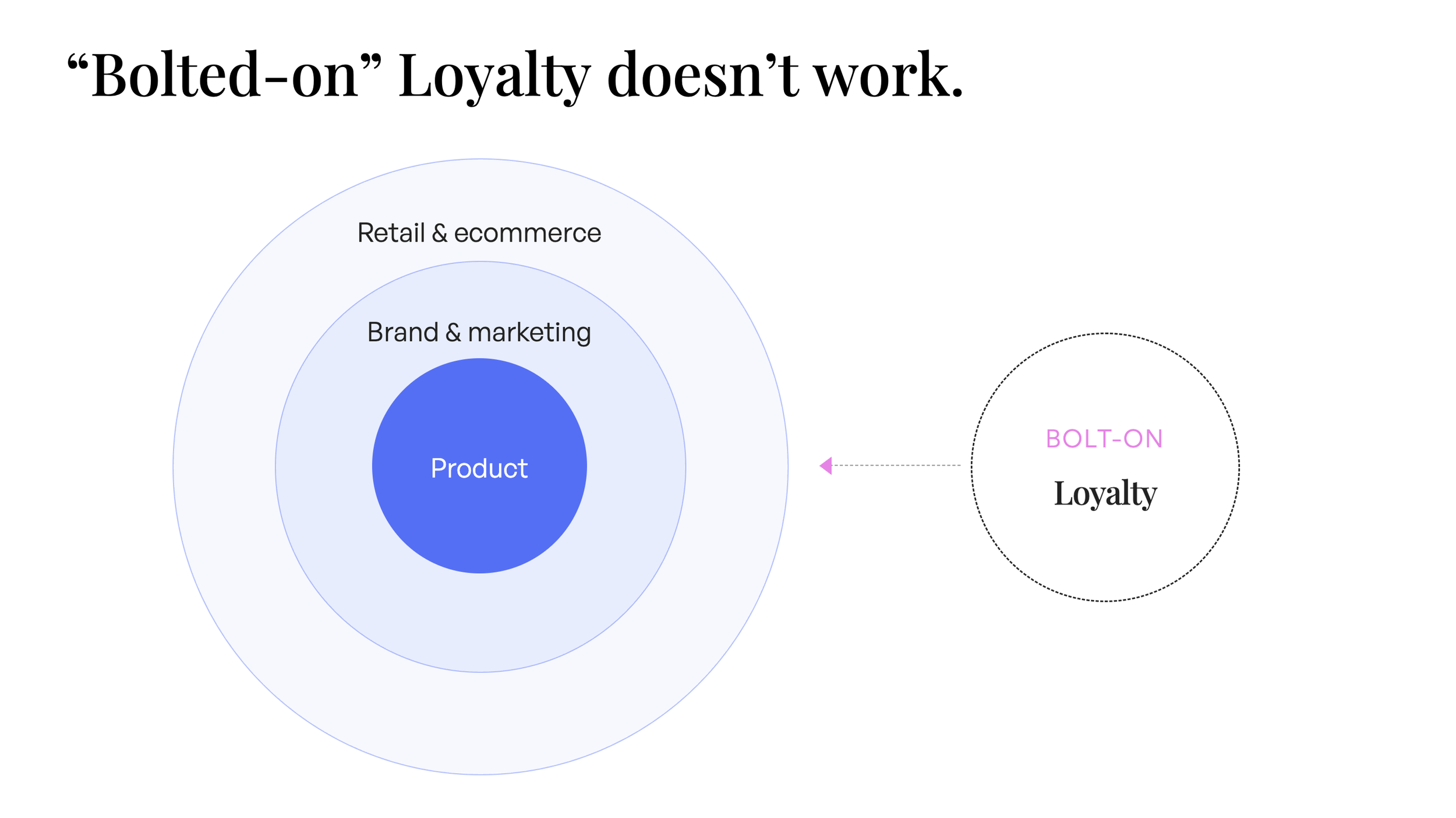
These are symptomatic moments of what I call “bolted-on” loyalty, where the initiative is not fully in sync with how the broader business operates.
What do we mean by “bolted-on”, why is this a problem, and how can we mitigate these situations? That’s today’s theme.
This is Part 2 of Before You Build — a content series for brand-side practitioners working through the important questions before any loyalty programme is designed. Each part is built around one diagnostic question, and together, they are designed to help you make loyalty programme decisions that are right for your brand. This article builds on Part 1, where we encourage you to first understand what your customers are “really” buying.
When I led loyalty marketing for a global fashion brand & retailer, I had to learn this lesson myself.
When we were redesigning the loyalty programme, we identified several promising new benefits & rewards based on research and customer surveys.
One of them involved an “in-store styling session”, where customers can book time with a store staff to try out the new seasonal collection and get expert recommendations on products that suit their style and body type. When we piloted this in a few markets, the customer response was, contrary to what we heard in surveys and focus groups, rather quiet.
On the other hand, another member benefit, “member early access to seasonal sales and product launches” worked much better than anticipated. Many products sold out during the early access phase, generating marketing buzz and additional demand on remaining products.
Here's what I've come to believe explains the different outcomes.
The styling session expected customers to adopt a new behaviour. Booking an appointment, setting aside time to come to stores. All actions they hadn't done before. Early access, on the other hand, tapped into a behaviour customers already showed. Anticipating and reacting to sale start and product drops. One benefit was trying to trigger a new behaviour from scratch. The other plugged straight into an existing behaviour fuelling sales and growth.
This distinction is the entire argument of this article:
The more you design your loyalty programme around how the customer behaves and how the business operates, rather than forcing something new to happen, the more it can support growth and the less likely it is to get sidelined.
Let’s unpack this further.
Funnels vs Loops
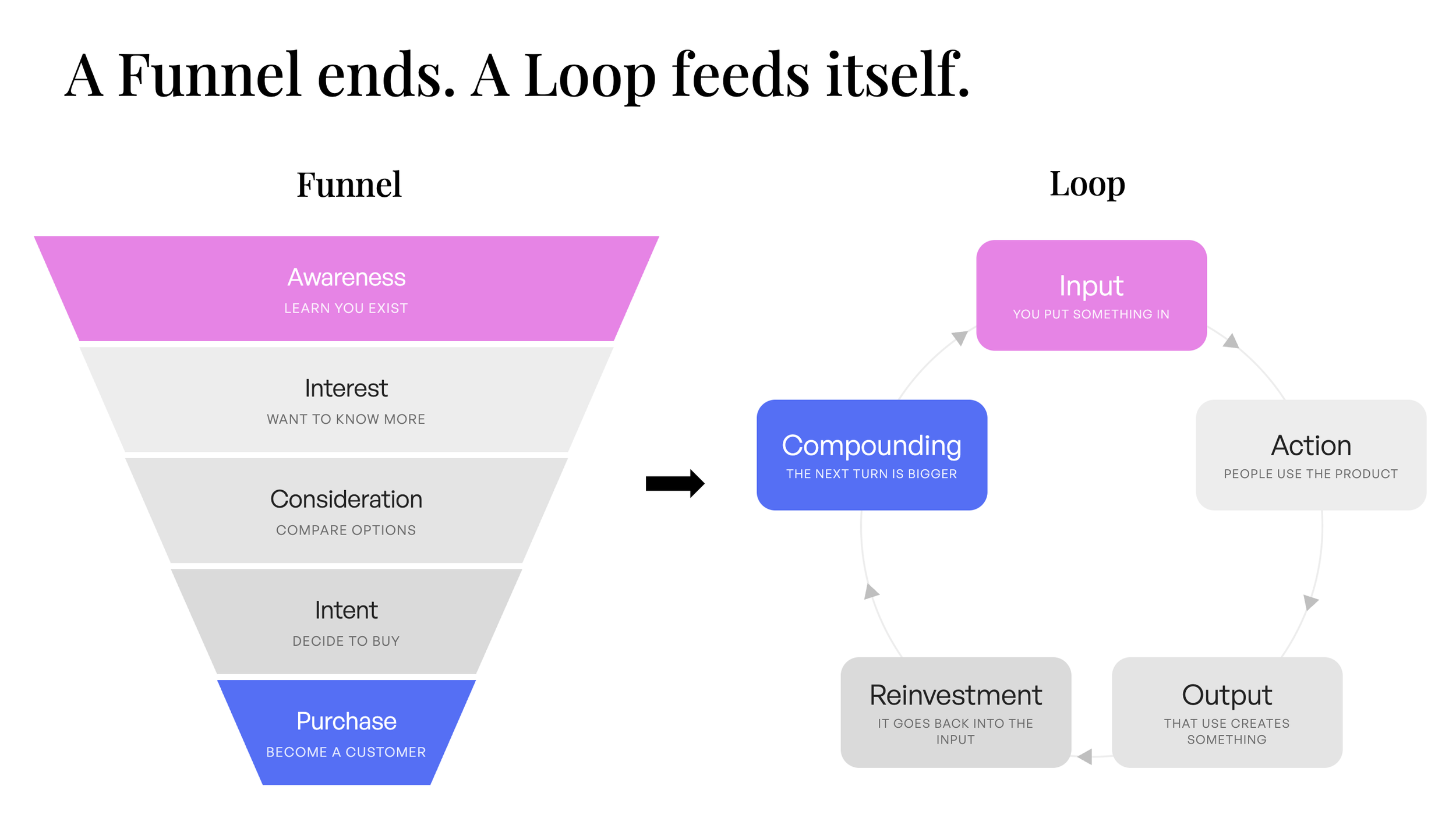
In order to identify how your business operates and achieves growth, I prefer to think in “loops” rather than “funnels”.
The problem with funnels is that all marketing “funnels” look identical. Because of that, the conclusions tend to be identical, too. “We need to invest more in X, Y and Z”. More, more and more.
As customer acquisition cost keeps going up, few brands have the luxury to keep pouring more (paid) budget into the marketing funnel, hoping enough sales and margin comes out the other end.
A more useful lens is to look for growth “loops” already at work in the business. In a loop, an initial input generates a business output, and the output itself becomes an input for the next loop, and the results compound over time.
A very simple example is a referral loop. It’s how Dropbox grew exponentially in its early stages.
Dropbox’s “referral” loop:
New customer starts using service →
Enjoys the experience and wants to collaborate with others →
Invites a friend to try out service →
Friend joins and uses service →
Friend enjoys, wants to collaborate with their colleagues →
Repeat
What makes growth “loop” thinking interesting is that it forces you to observe more carefully how your business really acquires, services, retains, and grows customers. It offers a way to identify and develop business growth strategies unique to your business. It empowers teams to think smarter, not (always) bigger.
Design loyalty mechanics around your growth loops
Once you’ve identified a few growth loops unique to your business, the job is to design loyalty mechanics that reinforce them, rather than sit beside them as a "nice-to-have.”
Let’s look at an example.
Sephora Beauty Insider’s “sample” loop
Yes, yes. I know that you know Sephora’s loyalty programme. Who doesn’t? It’s one of the industry benchmarks when it comes to loyalty. But - my take on why it works is that it plays into the natural growth loop in the beauty sector.
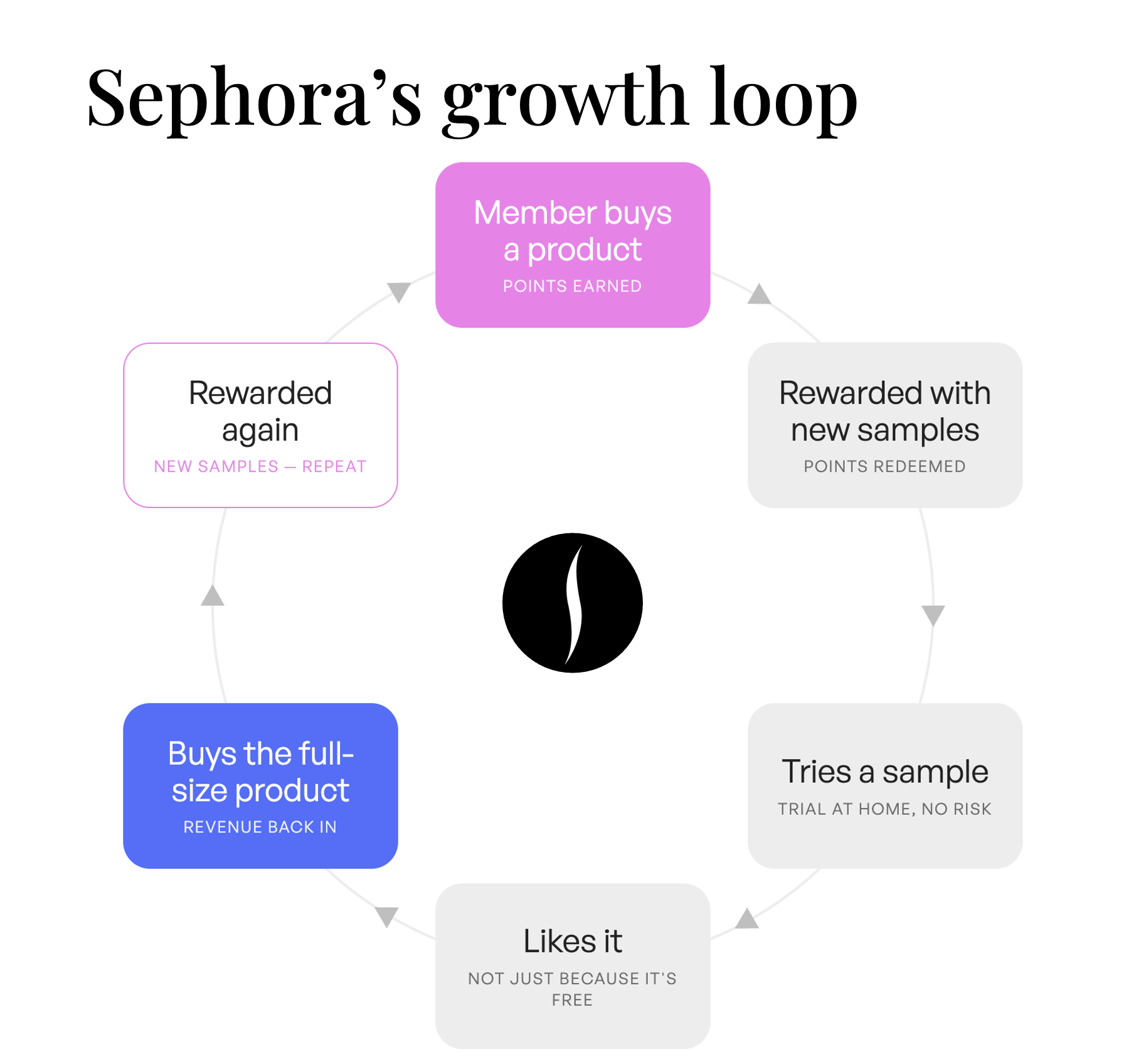
Sephora didn't invent a new loyalty mechanic and build it into their business. Rather, they identified a loop that existed naturally in the beauty industry - product discovery through sampling - and built their loyalty programme around it, and turbocharged the whole thing.
In Sephora’s case, the loyalty programme is the growth model. Loyalty doesn't sit beside the business, loyalty accelerates the business from within.
You’ve won if your loyalty programme is the growth loop
When loyalty is integrated into how the core business grows, everything compounds. It will give you the best chance to get your loyalty efforts embraced by the whole business. On the other hand, when it's bolted on, it gets treated as a “nice-to-have”, something you set aside when, you know, shit hits the fan…
In my previous example, early access to product launches and sales was part of the business’ core revenue & demand generating model. That’s why it worked. The in-store styling session was not. Therefore, it didn’t really work.
Key questions to sit with today
When designing your next loyalty programme, I invite you to tackle these two questions, which should help you ideate the right kind of experiences and benefits that actually help the business as well as the customer:
What are your brand’s unique growth loops?
How can you design loyalty mechanics that build on growth loops that already exist?
Because if you do, you have a much bigger chance of making a business impact.
Coming up next
In Part 1, we looked at how understanding what your customers are really buying is the starting point. Today, we talked about how designing loyalty around the business’ opertating model is critical for growth and survival. Next, in Part 3, we will look at how to know what kind of programme, if any, actually makes sense for your business.